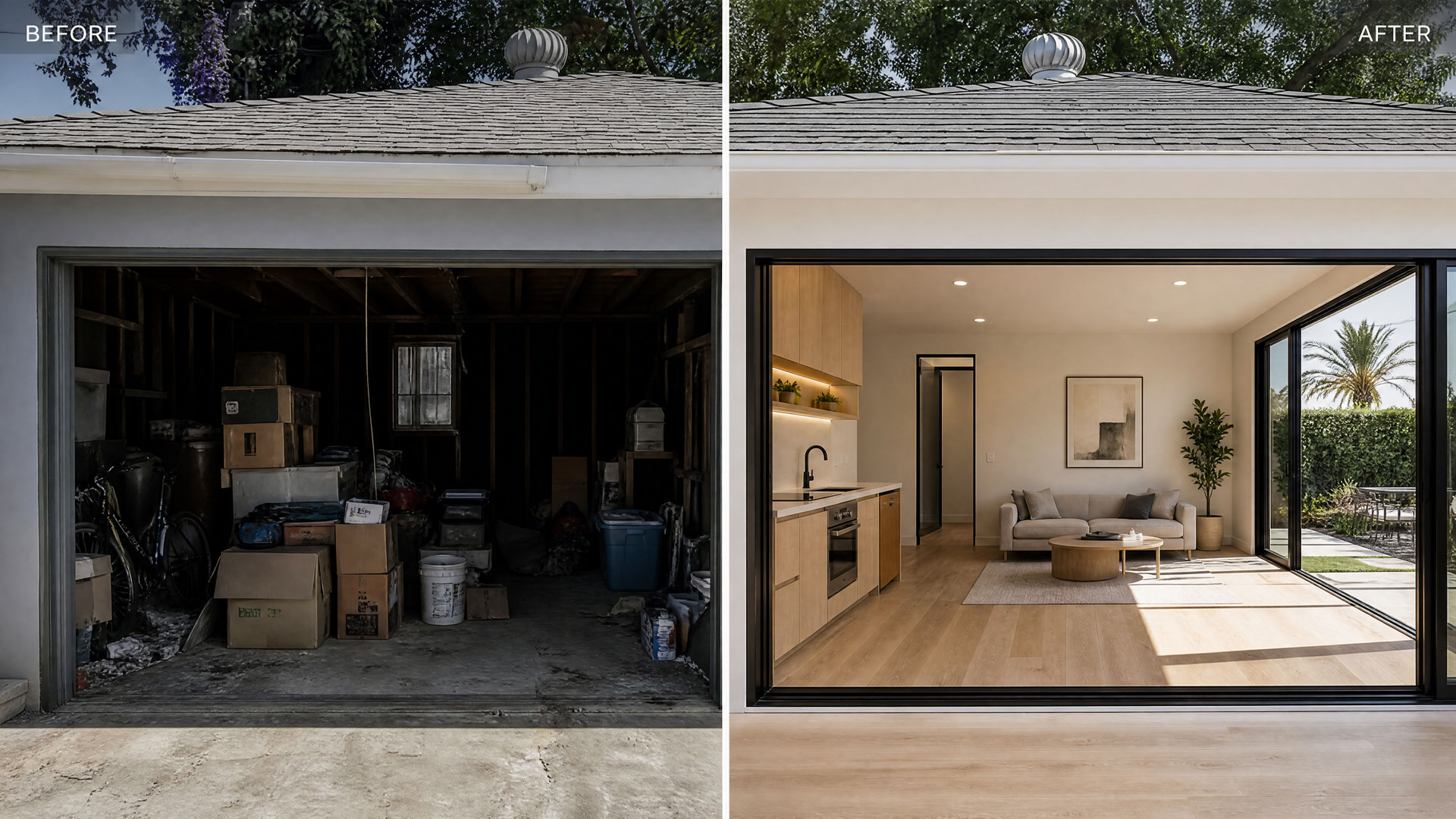
A converted garage is the most common unpermitted living space in Los Angeles, and it is also the case the 2025 law AB 2533 handles best. If your garage was converted into a living unit before January 1, 2020, you can usually legalize it on basic health-and-safety standards instead of full modern building code — and, importantly for a garage, without giving back a parking space. This guide covers what that means specifically for a converted garage: whether yours qualifies, what an inspector actually looks for, and what makes up the cost. PermitAmnesty is a confidential assessment service: we tell you which path pays off — legalize, remove, or sell — before anything is filed. Confidential. Nothing is filed with the city until you decide.
Why garage conversions are the easiest case under AB 2533
Most garage conversions share the same profile: a sound, permitted shell with framing and a roof that were already approved, plus interior work — drywall, electrical, sometimes a bathroom and kitchenette — that was never permitted. AB 2533 (Government Code §66311.7, formerly §66332) is built for exactly that. For a qualifying unit built before January 1, 2020, the city judges it on the substandard-housing standard in Health & Safety Code §17920.3, not the current code. So the question stops being “can this pass a 2026 inspection from scratch” and becomes “is it safe to live in” — a far lower and far cheaper bar.
One nuance: the amnesty covers units, not rooms
AB 2533 applies to unpermitted ADUs and JADUs — independent living units. A garage converted into a studio, a bedroom with a bathroom, or a full unit with a kitchenette fits that definition; a garage converted into a gym or a storage room is not a dwelling unit and follows the standard as-built permit route instead. Whether your specific conversion meets the unit definition (Gov. Code §66313) is one of the first things the assessment establishes.
The parking question — the part most owners get wrong
The single biggest fear with a converted garage is parking: owners assume the city will force them to restore a parking space, or add one somewhere else on the lot. For a qualifying conversion, that is not the case. State ADU law bars the city from requiring replacement parking when a garage, carport, or covered space is converted for an ADU — and SB 1211 extended that bar to uncovered spaces. That removes the one obstacle that historically pushed people to convert their garage back instead of legalizing it.
Does your garage conversion qualify?
The deciding factor is the date the conversion was done, not when you bought the house. AB 2533 covers qualifying units completed before January 1, 2020. You establish that with County Assessor records, old utility bills, escrow paperwork, transfer disclosures, code-enforcement records, leases, or dated aerial and satellite imagery — never on anyone’s word alone. If the conversion happened after that date, it does not qualify for AB 2533 and follows the standard retroactive-permit route to current code instead — more involved, but often still worth it.
What an inspector looks for in a converted garage
Because AB 2533 is about life safety, the corrections center on making the space safe rather than rebuilding it. For a converted garage, the items that come up most often are:
- Egress: a sleeping room needs an emergency escape window with a minimum net clear opening of 5.7 square feet — garages frequently have none, so this is the most common addition.
- Alarms: working smoke and carbon monoxide alarms inside and outside the sleeping area.
- Electrical: garage conversions are often wired informally, so exposed or hazardous wiring has to be corrected.
- Sanitation: if it functions as a full unit, a working toilet, sink, and kitchen sink with hot and cold water.
- Heating and ventilation: the space needs adequate heat and airflow for habitability.
- The rollup door: many conversions replace the garage door with a permanent wall and a window, but what your specific case needs is verified on site and set by the building department.
ADU or JADU?
How your converted garage is classified affects the rules. An attached garage counts as part of the residence for JADU purposes, so an attached conversion of 500 square feet or less within the existing footprint may qualify as a Junior ADU (JADU). A detached garage out back is typically legalized as a standard ADU. The distinction changes some requirements, and it is one of the first things the assessment sorts out.
What makes up the cost
There is no flat figure — the number is driven by how much life-safety work the unit needs, plus as-built plans and permit fees. What the law fixes in your favor: AB 2533 waives impact fees and connection and capacity charges (the narrow exception is utility infrastructure genuinely required to fix a §17920.3 condition), while standard permit and plan-check fees still apply. Your report gives preliminary ranges for your specific garage. All figures in every assessment are preliminary: final costs are set by the contractor you choose and by what the city approves.
Keep it, convert it back, or remove it?
Legalizing is usually the strongest move for a converted garage, because a permitted unit is counted by appraisers and lenders, while an unpermitted one is excluded from the official living area and has to be disclosed at sale. But it is not the only path. If the conversion cannot be legalized — or no longer makes sense for you — converting the garage back to a functional garage, or a permitted Remove & Restore that clears the violation, are both on the table. The assessment runs all of them against your situation so the choice is based on numbers, not guesswork — and that’s always your call.
Where to start — confidentially
For a pre-2020 unit, the right to a confidential third-party code inspection before filing anything is written into §66311.7 itself — the results are a resource for you, not a filing. PermitAmnesty works on that principle across every tier:
- Preliminary Assessment — $550. Remote: which path your garage is on (AB 2533 amnesty, as-built permit, or removal), a step-by-step action plan, and the legalize-vs-remove-vs-sell economics with preliminary ranges.
- Engineer-Reviewed Assessment — $850. Everything in the Preliminary, plus an independent desk review of your materials by a licensed engineer.
- On-Site Engineering Assessment — $1,650 (zone 1). A licensed engineer visits the property, and the engineer’s findings are built into your action plan. Priced by travel zone.
Every tier includes a 15-minute call to walk through your report — or written Q&A, your choice. And you can’t pick wrong: every tier credits into the next. If you then decide to build, licensed contractor partners build — ours or yours.
Get a Confidential Feasibility Report →
Service area
PermitAmnesty assessments cover the greater Los Angeles area: the first two tiers are remote, and the on-site tier is priced by travel zone, with out-of-zone addresses handled by custom invoice on request. Construction partners travel up to about 150 miles for the right project.
Get a Confidential Feasibility Report. Confidential. Nothing is filed with the city until you decide.
Frequently asked questions
Do I have to add parking to legalize my converted garage?
No, for a qualifying conversion. State ADU law bars the city from requiring replacement parking when a garage is converted for an ADU, and SB 1211 extended that bar to uncovered spaces.
My garage was converted before I bought the house — does it still qualify?
What matters is when the conversion was done, not when you bought. If it was completed before January 1, 2020, it can qualify; the date is proven with records and dated imagery, and documenting it is part of the assessment.
Does the garage door have to come out?
Often the rollup door is replaced with a wall and a window, but the exact requirement for your case is set by the building department and verified on site.
Can a detached garage be legalized too?
Yes. A detached converted garage is typically legalized as a standard ADU, while an attached one of 500 square feet or less within the footprint may qualify as a JADU.
How much will it cost?
There is no flat figure — the cost is driven by the life-safety corrections, the as-built plans, and permit fees. AB 2533 waives impact and connection charges; permit and plan-check fees apply. All figures in every assessment are preliminary: final costs are set by the contractor you choose and by what the city approves.
What if the conversion was done after 2020?
It does not qualify for AB 2533 and follows the standard retroactive-permit route to current code. The assessment tells you whether that still pencils out against removing or selling.
What is the most common fix?
Adding an egress window — most garages do not have one — along with smoke and CO alarms and correcting informal wiring.
Will the city know I had it assessed?
An assessment is an analysis of your property and your materials — nothing is filed with the city until you decide. For pre-2020 units, the right to a confidential third-party code inspection before applying is written into §66311.7 itself.
Who does the construction if I legalize?
PermitAmnesty does the assessment. If you continue, licensed contractor partners build — ours or yours: you are free to take your report to any licensed contractor you choose.
PermitAmnesty · Confidential assessments of unpermitted structures in greater Los Angeles. Construction partner: Kobzev Pro Contracting Group Inc., CSLB #1148495.